

What if the best years of your retirement are the first 10?
Imagine retiring at 60 with enough money to comfortably support yourself for the next 30 years.
You have spent decades building up your pensions and investments, and now you are finally in a position to enjoy the benefits of all that hard work.
But here is something I think is worth considering.
Is the money you spend at 65 potentially more valuable to you than the money you spend at 85?
Not necessarily in financial terms, but in what it allows you to do.
The big holidays, travelling, sporting activities and experiences you have been looking forward to might be much easier to enjoy in your 60s than in your 80s.
This raises an interesting question. Should we really be planning to spend the same amount throughout retirement?
Retirement is unlikely to look the same at 60 as it does at 85
When we think about retirement, it is easy to treat it as one long period, perhaps lasting 25 or 30 years.
But in reality, our priorities, interests, and spending habits are likely to change considerably during that time.
I think it is helpful to consider retirement in three broad phases.
1. Go-Go Years (Active retirement)
For many people, the first 10 or 15 years of retirement are likely to be their most active.
You might want to travel extensively, take on new hobbies, spend more time with family or enjoy experiences that you simply did not have the time for while working.
And if you have spent much of your career working long hours, there could be quite a few things on your list!
2. Go Slow Years (Quieter retirement)
As you get older, your priorities may gradually change.
Perhaps you prefer shorter holidays, spend more time at home or find that some of the activities you enjoyed in your 60s are becoming less appealing.
Your spending on travel and leisure might naturally reduce as a result.
3. No-Go Years (Later retirement)
In later life, health and mobility may become more important considerations.
You might spend less on holidays and entertainment but potentially more on healthcare, support at home or care needs.
Of course, everyone is different. I know there are plenty of people in their 80s who remain incredibly active, and there is no reason to assume everyone will follow the same pattern.
But I think the underlying point is important.
Your retirement lifestyle is unlikely to remain exactly the same for 30 years, so why should your financial plan assume that it will?
The difficulty of moving from saving to spending
One of the things I have noticed over almost 20 years as a financial planner is that people who have spent decades building wealth can find it surprisingly difficult to start spending it.
And I can understand why.
You have spent much of your working life earning, saving and investing. You have probably become quite disciplined about it, and those habits are not necessarily easy to change.
Then suddenly, you are expected to start drawing on the money you have worked so hard to accumulate.
There is no longer a regular salary coming in, investment markets can be unpredictable, and you have no way of knowing exactly how long your money will need to last.
It is perfectly understandable that people are cautious.
But I also think there is a danger of being so cautious that you end up missing opportunities to enjoy the wealth you have built.
There is a difference between making sure your money lasts and being unnecessarily restrictive about what you spend.
And that is where I think having a proper financial plan can make a real difference.
Could spending more in your early retirement years make sense?
Traditionally, retirement planning often starts with an assumed annual income requirement, which is then increased each year to allow for inflation.
For example, you might decide you need £70,000 a year to maintain your lifestyle throughout retirement. There is nothing inherently wrong with that approach.
But what if you would actually prefer to spend more in your 60s and early 70s, when you are likely to be particularly active, and less as you get older?
One option is to structure your retirement spending around those different stages of life.
For example, someone retiring at 60 might consider the following spending pattern:
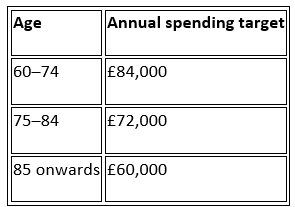
These figures are purely illustrative and expressed in today’s money.
The idea is to allow more money for holidays, experiences and activities during the earlier years, with spending gradually reducing as priorities change.
This is sometimes referred to as front-loading retirement expenditure.
Of course, it does not mean spending as much as possible in your 60s and hoping everything works out later!
It means deliberately considering how you would like to use your wealth at different stages of retirement and then establishing whether your finances can realistically support that approach.
And for some people, it could make a significant difference to how much they enjoy their retirement.
But what about the risks of spending more early on?
There are some important considerations before adopting this approach. For a start, nobody knows how long they are going to live.
If you retire at 60, your money might need to support you for another 30 or even 40 years.
There is also the risk of poor investment performance, particularly during the early years of retirement when you may be drawing substantial amounts from your portfolio.
If markets fall significantly while you are making withdrawals, it can have a lasting impact on how much capital remains to support your later years.
Inflation is another consideration, as are unexpected expenses, particularly around health and care.
And whilst spending on holidays and leisure might reduce as you get older, it would be unwise to assume your overall expenditure will necessarily fall.
That is why I think it is important to distinguish between essential expenditure and discretionary spending.
You will want to be confident that your core living costs can be supported throughout retirement, whilst potentially allowing greater flexibility around holidays, leisure and other expenses.
For some people, maintaining a relatively consistent level of spending will be more appropriate. For others, allocating more money to their earlier retirement years could be entirely reasonable.
The important thing is understanding the implications before making that decision.
How do you know whether you can afford to spend more?
This is where I think financial planning becomes particularly valuable.
Rather than simply assuming you need a certain amount of income every year, we can look at what you actually want your retirement to look like.
- How much would you like to spend during your first ten years?
- Are there particular holidays, experiences or major purchases you want to budget for?
- Would you expect your expenditure to reduce as you get older?
And how much flexibility would you have if investment markets performed less favourably than expected?
Through detailed cashflow modelling, we can test different scenarios and understand how your pensions, investments and other assets might support those plans.
For example, we could compare a consistent level of retirement spending against an alternative where you spend more during the first 10 or 15 years and gradually reduce that amount later.
We can also test the impact of poor investment returns, higher inflation, living longer than expected and other unexpected costs.
There are no guarantees, of course, but it gives you a much better basis for making decisions than simply hoping you have enough.
It may also be worth considering how secure sources of income, such as the State Pension or an annuity, could help cover essential expenditure, alongside maintaining appropriate cash reserves and investments.
And importantly, the plan should not be set in stone. Regular reviews allow us to adjust your spending plans as circumstances change, taking account of investment performance, your health, family commitments and what you want from retirement.
Making the most of the retirement you have worked for
I think there is a balance to be struck between making sure your money lasts throughout retirement and enjoying it while you have the health and opportunity to do so.
I am certainly not suggesting everyone should spend more in their 60s.
For some people, maintaining a consistent level of income will be the right approach. Others may want to preserve more wealth for their children or grandchildren, or retain greater financial security against future care costs.
But if you have accumulated substantial wealth, I think it is worth considering whether your retirement spending plans genuinely reflect how you want to live.
After all, you have probably spent decades making sensible financial decisions to get yourself into this position.
Having enough money to enjoy something at 85 is not necessarily the same as having the opportunity to enjoy it
And if you could comfortably afford to spend more during your earlier retirement years, would it not be useful to know?
That is exactly the sort of question I help clients explore through financial planning.
If you would like to understand what your own retirement plans could realistically support, please get in touch.
You can call me on 07769 156250.
Please note
This blog is for information purposes only and does not constitute advice or a personalised recommendation. The information is intended only for individuals.
Please do not act based on anything you might read in this article. This blog is based on our understanding of current and proposed legislation, which may change.
The value of your investments (and any income from them) can go down as well as up, and you may not get back the full amount you invested. Past performance is not a guide to future performance.
Investments should be considered over the longer term and should fit in with your overall attitude to risk and financial circumstances.
When investing, your capital may be at risk.