

5 effective ways you can prevent a market crash from derailing your retirement plans
Although I’ve used it in the title of this article, I’m always reluctant to describe any big fall in stock market values as a “crash”. To my mind, it’s a scaremongering term that is used for effect rather than as an accurate description.
Dictionaries describe “crash” as a violent collision, usually in which vehicles are damaged, and people get hurt.
While there’s no doubt that a dramatic fall in share prices can be unsettling, there’s no reason why there should be any long-term adverse effects on your finances.
With the right strategy and effective planning, you can mitigate the effect of a significant stock market downturn and stay on track towards the retirement you’ve looked forward to.
With markets currently at record all-time highs, speculation starts to turn to how long this can last, with fears of the “AI bubble” bursting, and geopolitical tensions – particularly in the Middle East – creating widespread uncertainty. While I’m not saying a big downturn is inevitable, it pays to remind ourselves how we should plan for such events, which are likely to happen sooner or later.
Here are five key factors your planning should incorporate.
1. Making sure you have the correct mix of assets
One of the most effective ways to secure your long-term financial future is through diversification.
Spreading your investments across different asset classes can help mitigate the risk of a sudden market downturn as low-risk assets, such as bonds and fixed-interest holdings, provide stability that can offset losses elsewhere.
Likewise, your portfolio should be diversified across regions and sectors. Different sectors react differently to most market downturns, and a spread of assets can help mitigate risk.
I appreciate how tempting it can be to invest in the big tech companies that currently dominate the markets. However, an effective long-term investment strategy should follow a rule whereby you should never own enough to make a killing or be killed by an investment.
It’s also clearly important that your investment strategy reflects your own attitude to risk and capacity for loss.
As you accrue wealth, you are likely to accept a higher level of risk, as you have time to overcome big losses. However, as you get closer to retirement, a time when you will start living on the value of your accrued wealth, you may want to consider a more balanced approach that includes a greater proportion of lower-risk investments.
My approach tends to be to hold what needs to be spent in cash over the next three years, as history shows markets will typically recover over that timeframe. The rest should be invested.
2. Always ensure you have an emergency fund
I always recommend maintaining an emergency fund covering three to six months of living expenses in a readily accessible account.
It’s prudent for everyone to do this, regardless of where you are in your financial journey. But it’s particularly important when you are close to or in retirement. In these circumstances, I’d actually recommend an emergency fund of six to twelve months’ expenses.
Having several months of income in a secure account provides you with some breathing space in the event of a downturn, and means you aren’t selling investments at a low price to provide income. In this way, a severe market upheaval won’t upset your plans.
3. Maintaining an effective income strategy
Maintaining an emergency fund should be just one part of a wider income strategy for your retirement.
You will need to find the right balance between continuing to invest for growth and maintaining a suitable level of investment security, meaning you do not sell investments at a loss.
Major market events can affect all stocks, so during market downturns, you might find that some very valuable companies are underpriced. This can create opportunities to purchase blue-chip shares at a competitive price.
You should also look to review your income strategy regularly. Your income needs will likely change as you go through your retirement, so your strategy should reflect this.
4. Regularly rebalancing your portfolio
Another key investment strategy to help protect you against market turbulence is to regularly rebalance your portfolio.
This involves selling assets that have increased in value beyond their target allocation and purchasing those that have fallen below it.
Doing this can help ensure you always have a risk level appropriate to your long-term plans.
It also means that you are selling assets at high prices while purchasing others at low prices.
5. Not panicking at signs of market turbulence
In addition to tangibly managing your finances, it’s important to consider the emotional challenges you may face.
In this regard, there’s a lot to be said for ignoring the news and tuning out the noise.
I have heard, on more than one occasion, the word “news” described as an acronym for “Negative Events World Service”! I believe there’s a lot of truth in that.
From a financial perspective, you can always expect the media to overreport the impact of a market downturn. Fear and negativity sell, while good news doesn’t, so you’ll never see a headline about “billions being wiped on” the value of the stock market.
That’s not to say downturns aren’t stressful, especially if you are close to retirement and suddenly see your portfolio value decline by 20% or more.
But it’s at times like that when it’s critical to think clearly and not to panic. If you sell, you’ll be making a loss. Having enough cash to draw on, whilst staying invested and maintaining a long-term perspective, has historically led to better outcomes than panicking or attempting to time the market.
This chart illustrates the point perfectly. Since the start of this decade, there have been six events that have prompted sudden market movement. Yet over that time, the S&P 500 index has more than doubled in value.
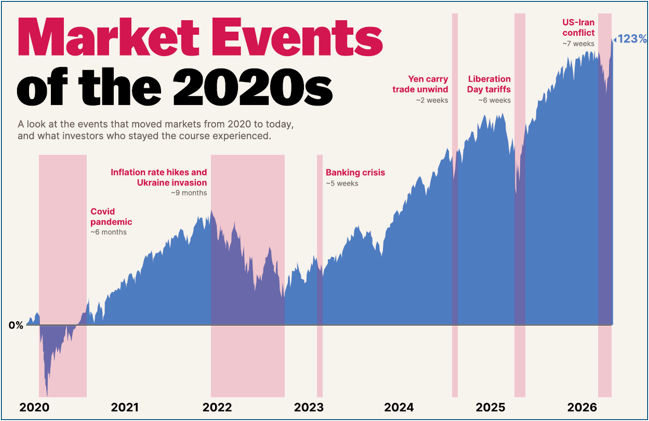
Source: Humans Under Management
In an article I published a couple of years ago, I likened your reaction to market downturns to how you should react to blizzards, and your investment strategy in the event of such a downturn as your lifeboat drill. I’d recommend you take a look.
Get in touch
Downturns are quite simply a fact of investment life; they are a feature, not a bug, and not a reason for panic. By planning ahead and focusing on your long-term objectives, you can maintain confidence in your financial future.
If you would like to discuss your own financial plans, please get in touch.
You can call me on 07769 156250.
Please note
This blog is for information purposes only and does not constitute advice or a personalised recommendation. The information is intended only for individuals.
Please do not act based on anything you might read in this article. This blog is based on our understanding of current and proposed legislation, which may change.
The value of your investments (and any income from them) can go down as well as up, and you may not get back the full amount you invested. Past performance is not a guide to future performance.
Investments should be considered over the longer term and should fit in with your overall attitude to risk and financial circumstances.
When investing, your capital may be at risk.